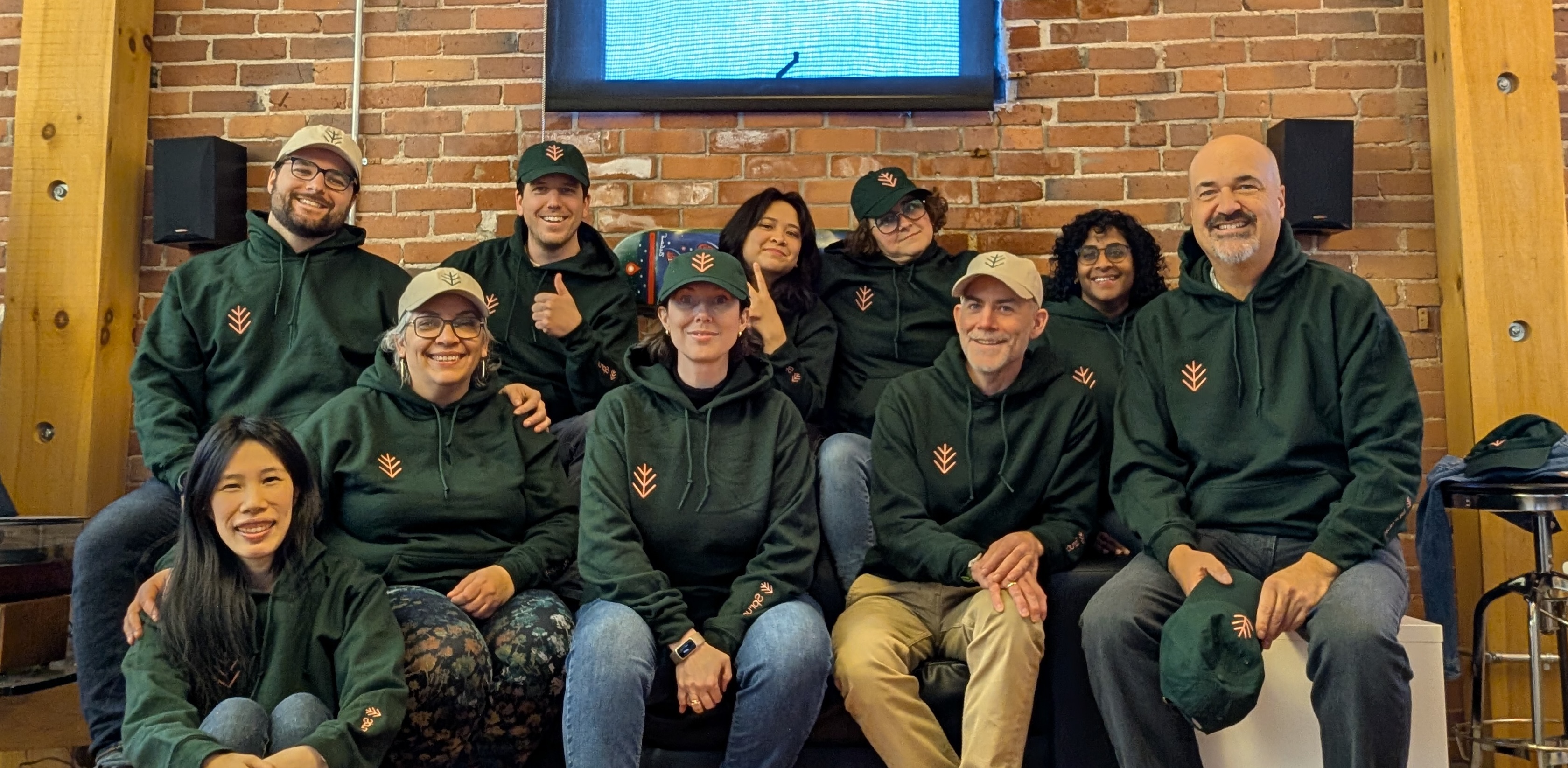
Ten years ago, Spruce began as a small creative agency much like any other: a designer and a writer who enjoyed working together, ready to dream a little bigger. Our individual visions weren’t identical, but our values and experience overlapped enough to create a root system that took hold.
We named the agency Spruce Creative after the street where our first office was located. Not exactly groundbreaking—“You’ll never be able to move!” people joked—but maybe that’s besides the point. Creativity isn’t always about where an idea comes from. It’s about what it becomes.
Today, we usually call ourselves Spruce. It’s short, simple, and yes, it lends itself to the occasional “sprucing things up” pun (which we try to avoid). More importantly, it communicates growth. It feels like us. We could move to Elm Street and it wouldn’t matter.
So how did we get here? A few growth rings stand out.
We Focus on Community-Building Projects
A couple of years in, we were still figuring out what Spruce should be. We had early wins—like helping Tamarack Ottawa Race Weekend grow into one of Canada’s biggest running events—and a few not-so-great fits, mostly in the private sector. In late 2016, a consultant helped us sharpen our value proposition, and it changed everything.
At Spruce, we bring a deep understanding of—and a true passion for—the marketing and branding challenges faced by organizations that focus on building strong, vibrant communities—associations, municipal governments, developers and event organizers.
From that point on, we oriented ourselves toward community-building work. We still take on private-sector clients, but typically those with a strong community ethos (like our long-time friends at Red Apron). In recent years, our work has further crystallized around four interrelated sectors: City Building, Human Development, Indigenous Priorities and Sustainability.
We Articulate Our Values
By 2019, we’d grown to a team of about 10 creatives working elbow-to-elbow in our little Spruce office. We were building something special, but we hadn’t actually written down what made our culture work.
During our first team retreat, which has since become an annual tradition, we spent a day defining our values (you can find them on our About page). The timing couldn’t have been better; within a year, we’d all be scattered to our home offices during the pandemic, anchored by what we’d captured together.
One value worth highlighting is the somewhat odd “Balance, Flexibility and Fun is our BFF.” That commitment, not only to work-life balance, but to the flexibility necessary to create that balance (e.g., being able to work in a different time-zone) has shaped how we collaborate as a team that is now spread across the country.
We Become a Majority Indigenous-Owned Company
I started my career as a copywriter more than twenty-five years ago. My first Creative Director was Paul Marconi (founding partner of Spruce). Back then, I didn’t know much about Paul’s family history—just that “Marconi” sounded Italian. It was only after we started Spruce that I learned that Paul identified as Métis, his mom’s family line tracing to Northern Alberta and to the Red River Settlement (now Winnipeg). Like many Indigenous families, Residential Schools and the Sixties Scoop were traumas his family had endured.
I also learned it mattered to Paul that Spruce eventually become a majority Indigenous-owned company. As our work with Indigenous organizations grew, I felt torn. We had a diverse team, but not a diverse Indigenous team. At the same time, I could hear in conversations with clients how meaningful it was to work with companies that had Indigenous ownership.
During that time, we had also been collaborating closely with Guy Freedman and First Peoples Group, and after some thoughtful discussions, Guy joined as a Partner—making Spruce a majority Indigenous-owned company in 2021.
Paul often says, “I’m not an Indigenous graphic designer; I’m a graphic designer who is Indigenous.” I’d say the same about Spruce. We’re not an Indigenous creative agency. We’re a creative agency with Indigenous ownership. And while we’re proud to support Indigenous organizations and reconciliation-focused projects, we’re interested in all projects that make our communities better.
We think this approach aligns with the future Canada should be building. One where Indigenous people are owners, partners and leaders across every sector and project, not just those with a specifically Indigenous mandate. In our own way, we’re testing one version of that future at Spruce.
(This topic deserves a longer article—coming soon.)
Looking Forward
There are many more growth rings to this story, but this feels like the right place to pause (and we do need to get this out before the holidays!).
As we finish our tenth year, I’m proud to be part of building a company rooted in a city I love, on unceded, unsurrendered Algonquin Anishinaabe territory I’m grateful to call home. A company led and shaped by people I admire, doing excellent work for organizations that make a difference in our communities.
Who knows what the next decade will bring, but it feels like this is the start of something good.
Andrew Vincent is a Partner and Strategy Director at Spruce.